Python vs Java: Which Should You Learn?

Imagine this — you’re sitting in front of your laptop, scrolling through tech career options. You want to start learning programming, but one question keeps bugging you:
“Should I learn Python or Java first?”
You’re not alone. Every aspiring developer faces this choice at some point. Both Python and Java are powerful, widely used, and in high demand — yet they serve different worlds. One focuses on simplicity and innovation, the other on structure and scalability.
So, let’s explore this in a way that helps you make a confident choice.

Meet Python – The Friendly Language
Think of Python as that approachable teacher who makes even tough topics sound simple.
Its syntax is clean, readable, and feels almost like English. You don’t have to worry about brackets, data types, or lengthy code. That’s why beginners fall in love with it.
Python is the go-to language for data science, machine learning, web development, automation, and artificial intelligence. It allows you to focus on problem-solving, not syntax memorisation.
Meet Java – The Systematic Powerhouse
Now, imagine Java as a strict but helpful teacher who believes in doing things the right way.
It uses fixed rules and needs more lines of code, which helps you learn to write clean and organised programs.
And that’s exactly why Java remains the backbone of enterprise software, Android apps, and large-scale backend systems.
In short:
- Python = quick to learn, great for beginners
- Java = structured, great for mastering computer science fundamentals
Step 2: Ease of Learning — Which One Feels Simpler?
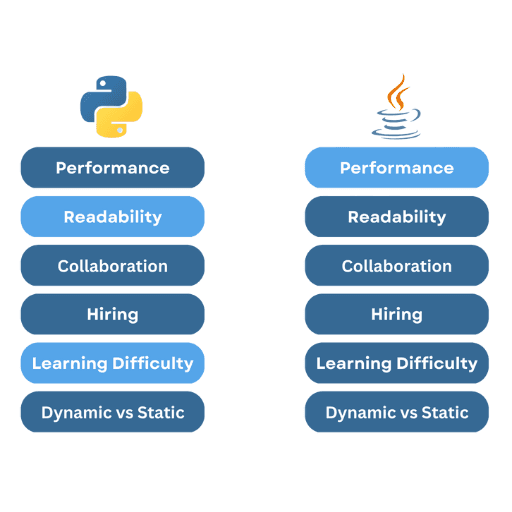
If you’re completely new to programming, Python might feel like a breath of fresh air. You can start coding on day one. The simple syntax helps you learn logic and concepts without getting tangled in technicalities.
Java, on the other hand, demands more patience. You’ll spend time understanding classes, data types, and methods. But that discipline will reward you later when you’re dealing with real-world projects.
So, while Python gives you a quick start, Java builds long-term strength.
Step 3: What Can You Build with Each?
Picture this:
You’ve mastered the basics — now what can you actually do with these languages?
|
Area |
Python Excels In |
Java Excels In |
|
Django, Flask, FastAPI – quick & lightweight |
Spring Boot – scalable & enterprise-grade | |
|
Mobile Apps |
Limited use (Kivy, BeeWare) |
Core Android development |
|
Data Science & AI |
Dominates with NumPy, Pandas, TensorFlow |
Minor presence with enterprise AI tools |
|
Automation & Scripting |
Great for repetitive tasks and DevOps |
Heavier for simple scripts |
|
Large Systems & Banking |
Less common |
Industry favourite for reliability and performance |
So, if you dream of creating AI tools or automation projects, Python is your best friend.
If you want to build Android apps or large-scale backends, Java is your loyal companion.
Step 4: The Learning Curve — Quick Wins or Deep Mastery?
When you start learning Python, you’ll quickly build small projects — calculators, web apps, even chatbots. That instant gratification keeps motivation high.
With Java, your journey feels slower in the beginning. But when you finally build your first project, you’ll understand the logic and structure behind every line. It’s the kind of knowledge that stays with you for years.
So, if you want instant creativity, go for Python.
If you want deep-rooted coding discipline, Java’s your choice.
Step 5: Performance and Scalability
Here’s a simple way to look at it:
- Python runs slower but helps you develop faster.
- Java runs faster but takes longer to code.
Python’s flexibility makes it perfect for innovation, experimentation, and data-driven work. But when it comes to performance — such as banking apps or enterprise platforms handling millions of users — Java shines with its JVM (Java Virtual Machine) and multithreading capabilities.
If speed and scale matter, Java wins.
If creativity and productivity matter, Python rules.
Step 6: Job Demand and Career Growth
Let’s talk about what really matters — your career.
Python Careers
Python developers are everywhere — from data scientists building AI models to web developers creating modern APIs. The demand for Python keeps growing because of its versatility and dominance in AI, ML, and data analytics.
Java Careers
Java continues to power enterprise software, Android apps, and fintech systems. It’s a core language for organisations that value stability, security, and scalability.
Here’s the truth: both Python and Java have strong job markets. The difference lies in where you want to go.
Want to work on AI and automation? Choose Python.
Want to work in corporate software or Android development? Choose Java.
Step 7: Salary and Industry Insights
- Python developers often earn higher salaries in AI and analytics roles due to rising global demand.
- Java developers earn stable and competitive pay in enterprise and backend roles — especially in fintech, banking, and product-based companies.
Both are financially rewarding, but Python currently has a slight edge because of its dominance in emerging technologies.
Step 8: So… Which Should You Learn First?
Let’s make it simple:
|
Your Goal |
Recommended Language |
|
You’re new and want an easy start |
Python |
|
You’re aiming for AI or data science |
Python |
|
You’re targeting Android or enterprise jobs |
Java |
|
You love structure and logic |
Java |
|
You want to automate tasks or analyse data |
Python |
|
You want a long-term, scalable career in backend |
Java |
If you’re still unsure — start with Python. It’s easier to pick up, helps you see results fast, and opens multiple paths later. Once you’re confident, you can move to Java to gain more depth and structure.
Many successful developers learn both — using Python for creativity and Java for performance.
Step 9: Final Verdict
At the end of the day, Python vs Java isn’t a battle — it’s a choice between two different strengths.
- Python is for those who love simplicity, innovation, and speed.
- Java is for those who value discipline, structure, and scalability.
Both can shape a successful tech career — it all depends on what kind of developer you want to become.
So, take a deep breath, pick one, and start coding.
Because in programming, the best language is the one you actually use.
Written by
Shreyashri
Last updated
11 October 2025