Synthetic vs Real Data: Can AI Learn From Both?
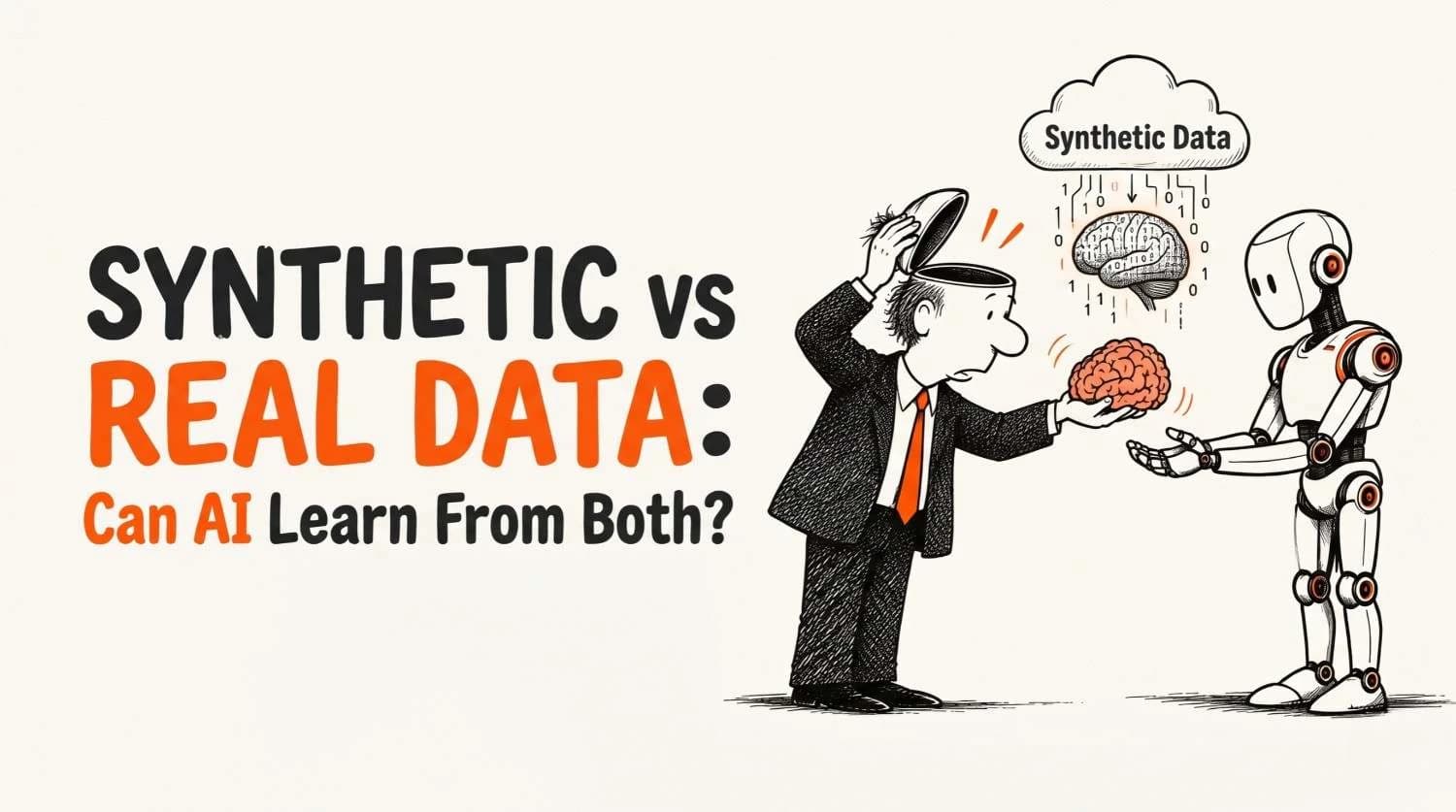
Artificial intelligence depends on data, but collecting enough high-quality information to train machine learning models is not always easy. Some datasets contain sensitive personal information, others lack examples of rare situations, and certain industries have limited access to reliable training records.
Synthetic data offers another approach. Instead of collecting every example from the real world, developers can generate artificial datasets that reproduce selected patterns, characteristics and relationships found in existing information.
But can AI models learn effectively from artificial information? And does combining synthetic and real data produce better results than using either independently? Understanding the differences helps developers build machine learning systems that are more reliable, representative and useful in real-world applications.
Real data consists of information collected from actual events, people, transactions, devices or environments. It represents observations of the world rather than artificially generated examples.
For example, a financial institution may use historical transaction records to train a fraud detection model. A healthcare organization might use properly governed patient records to develop systems that identify potential health risks.
Real-world datasets are valuable because they capture actual behaviour, including unexpected patterns, irregularities and complex relationships.
However, real data also has limitations. Collecting, cleaning and labeling it can require significant time and resources. Privacy restrictions, missing information, class imbalance and inconsistent data formats can further complicate the training process.
These limitations create opportunities for synthetic data.
Synthetic data is artificially generated information designed to represent selected characteristics or patterns of real-world data.
Unlike real data, it does not necessarily come from direct observations. Instead, developers use statistical methods, simulations or generative AI models to create artificial examples for specific purposes.
Common synthetic data generation techniques include:
Generative Adversarial Networks (GANs): Two neural networks compete during training to generate increasingly realistic examples.
Variational Autoencoders (VAEs): Models learn compressed representations of data and generate new samples from a learned probability distribution.
Diffusion Models: These models learn to generate data by reversing a gradual noise process.
Simulation-based generation: Developers create artificial environments and scenarios using predefined rules, mathematical models or physics-based simulations.
LLM-based generation: Large language models generate artificial text, conversations, instructions and other language-based examples.
For instance, developers training an autonomous driving system can simulate different road conditions, lighting environments and traffic situations instead of relying exclusively on recorded driving footage.
The usefulness of generated data depends on how accurately it represents the characteristics required by the intended machine learning task.
Although both data types can support machine learning, they differ in how they are collected, generated and evaluated.
Comparison | Real Data | Synthetic Data |
Origin | Actual observations | Artificial generation |
Collection | Sensors, transactions, surveys and records | Generative models and simulations |
Availability | Can be limited | Can be generated at scale |
Privacy | May contain sensitive information | Can reduce exposure when properly generated |
Data diversity | Depends on actual observations | Can target specific scenarios |
Accuracy | Reflects observed events, subject to measurement errors | Depends on generation quality |
Main limitation | Collection, labeling and access | Fidelity, bias and artificial patterns |
One important distinction is that synthetic data is not automatically accurate or anonymous. Artificial examples may reproduce errors or sensitive patterns from their source datasets.
Yes. Machine learning models can be trained using a combination of synthetic and real datasets. This approach is particularly useful when real-world examples are insufficient for certain categories or situations.
Synthetic data can supplement existing training information, while real data helps maintain a connection to actual conditions.
Consider a fraud detection system. A financial dataset may contain thousands of legitimate transactions but relatively few confirmed fraudulent activities. This imbalance can make it difficult for a model to recognize less common fraud patterns.
Developers can generate additional synthetic examples representing selected fraud scenarios and combine them with genuine transaction records. The model then receives a broader range of training examples.
However, generated examples must be reviewed carefully. If they contain unrealistic transaction patterns, the model may learn artificial signals instead of meaningful indicators of fraud.
The goal is not simply to increase dataset size. It is to improve the quality and coverage of the information used during training.
1. Better Coverage of Rare Scenarios
Real datasets may contain too few examples of unusual events. Synthetic generation allows developers to create additional examples for underrepresented conditions.
This can help applications such as fraud detection, industrial fault prediction and autonomous vehicle development.
2. More Flexible Data Augmentation
Synthetic data can expand existing datasets by introducing controlled variations in text, images, numerical records or simulated environments.
For example, computer vision developers can generate images with different lighting conditions, backgrounds and object positions to help models handle more visual variations.
3. Reduced Dependence on Sensitive Records
In privacy-sensitive industries, synthetic datasets can provide an alternative for certain development, testing and data-sharing workflows.
However, synthetic data does not guarantee privacy. The National Institute of Standards and Technology (NIST) warns that synthetic datasets generated without appropriate privacy protections may remain vulnerable to information leakage and privacy attacks.
4. More Efficient Development and Testing
Developers can generate controlled datasets to test model behaviour before sufficient production data becomes available.
This is particularly helpful for evaluating edge cases, testing different input conditions and creating repeatable development scenarios.
Synthetic data can improve dataset coverage, but excessive reliance on generated examples introduces important risks.
Inherited bias: If the original dataset underrepresents certain populations or behaviours, a synthetic generator may reproduce those limitations.
Reduced data fidelity: Artificial examples may preserve broad statistical patterns while missing important relationships between individual variables.
Unrealistic examples: Generative models can produce records that appear convincing but do not reflect real-world conditions.
Privacy leakage: A generator trained on sensitive information may reproduce details of its training examples. Synthetic data should not automatically be treated as anonymous.
Model degradation: Repeated training on low-quality or recursively generated data can reinforce errors and reduce the diversity of learned patterns.
A 2025 study published in iScience examined the trade-off between fidelity, privacy and machine learning utility in synthetic patient data. Its findings demonstrate why synthetic data quality and privacy protection must be evaluated together rather than assumed from the generation method alone.
Developers should treat synthetic data as a controlled addition to a training pipeline rather than an automatic replacement for real observations.
A practical workflow involves five stages:
1. Identify the data gap: Determine whether the problem involves limited examples, class imbalance, privacy restrictions or missing scenarios.
2. Select a generation method: Choose an appropriate technique based on the data type, including GANs, VAEs, diffusion models, simulations or language models.
3. Generate and validate samples: Check whether artificial examples preserve relevant statistical distributions, feature relationships, labels and realistic constraints.
4. Combine datasets carefully: Introduce synthetic samples into the training dataset while tracking their origin and controlling their contribution.
5. Evaluate on independent real data: Test the trained model using real-world examples that were not used to generate the synthetic dataset or train the model.
The final stage is especially important. A model that performs well on synthetic validation examples may still fail when exposed to actual users, transactions or environmental conditions.
Track data provenance: Maintain records showing which examples are real and which are generated.
Measure model performance: Compare precision, recall, F1-score and other task-appropriate metrics across training strategies.
Check subgroup performance: Examine whether synthetic augmentation improves or worsens results for underrepresented populations.
Preserve a real-world test set: Avoid relying exclusively on synthetic validation data.
Review privacy risks: Use appropriate privacy assessments and safeguards before sharing generated datasets.
1. Is synthetic data as good as real data for AI training?
Not always. Synthetic data can provide useful training examples, particularly when real data is limited. However, its effectiveness depends on how accurately it represents the patterns and relationships required by the machine learning task.
2. Can AI models be trained entirely on synthetic data?
Yes. Models can be trained using entirely synthetic datasets, but performance on real-world inputs must be evaluated independently. Synthetic-only training can be problematic when generated data fails to capture important real-world variations.
3. Does synthetic data improve machine learning accuracy?
It can improve performance when it adds useful examples, addresses class imbalance or expands scenario coverage. However, low-quality synthetic data can introduce misleading patterns and reduce generalization.
4. How is synthetic data generated?
Synthetic data can be generated using GANs, VAEs, diffusion models, statistical techniques, simulations and large language models. The appropriate method depends on the data format and intended application.
5. Is synthetic data completely privacy-safe?
No. Synthetic data may still reveal information about its original training records, particularly when generated without formal privacy protections. Privacy risks should be evaluated before using or sharing generated datasets.
Synthetic and real data serve different but complementary purposes in artificial intelligence. Real data provides observations of actual conditions, while synthetic data can expand training coverage, simulate uncommon situations and support development when access to real information is restricted.
Combining both can strengthen machine learning workflows, but only when generated examples are realistic, representative and carefully validated.
For developers and data scientists, the priority should be data quality rather than dataset size. Synthetic data can make AI training more flexible, but independent real-world evaluation remains essential for building models that perform reliably
Written by
Alaffiya Madarwala
Last updated
26 November 2026
Comments
In this article
What Is Real Data in AI Training?
What Is Synthetic Data in Machine Learning?
Synthetic Data vs Real Data: Key Differences
Can AI Learn From Both Synthetic and Real Data?
Benefits of Combining Synthetic and Real Data
Risks and Limitations of Synthetic Data
How to Combine Synthetic and Real Data Effectively
Expert Tips
Frequently Asked Questions
Conclusion