SQL vs Python: What Should Beginners Learn First?
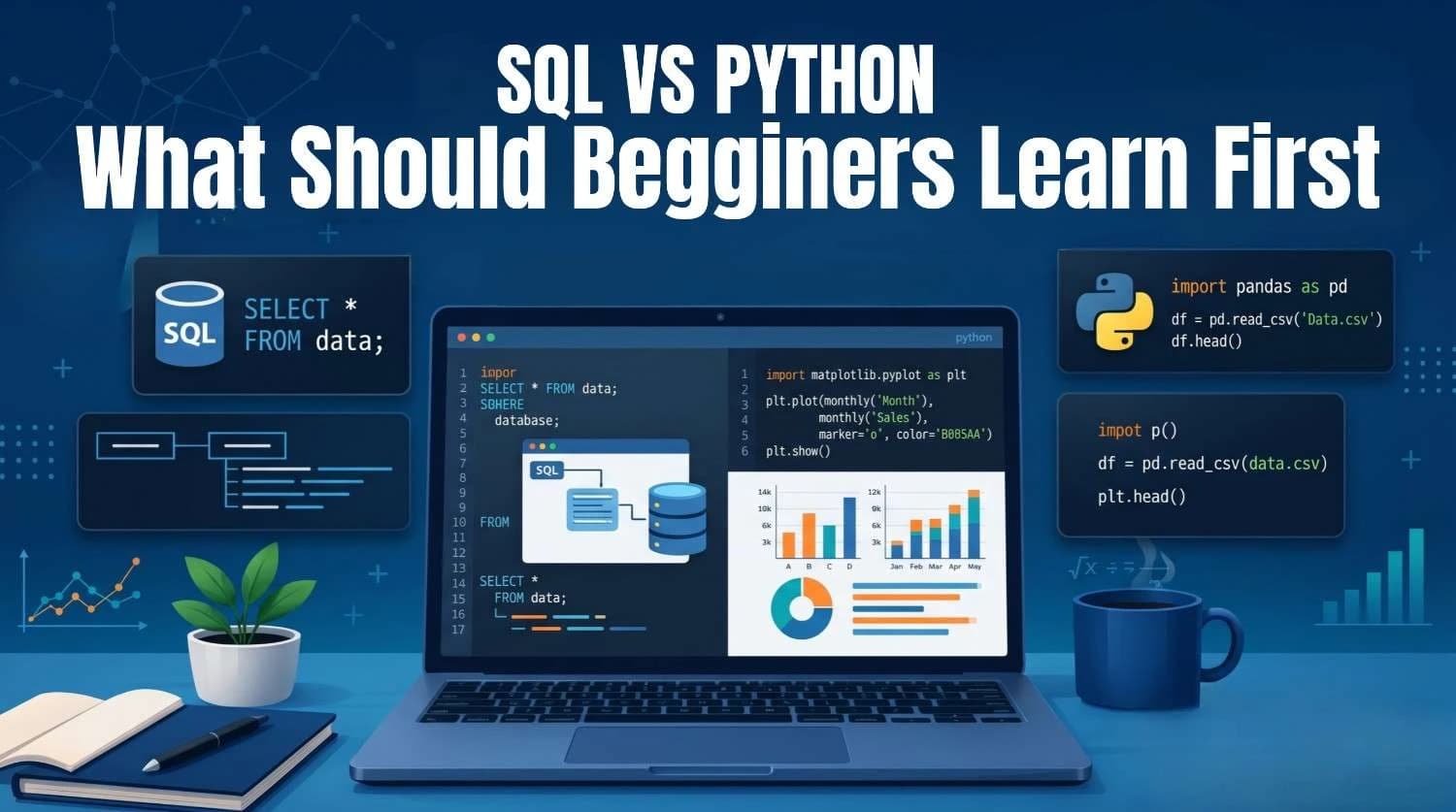
Choosing between SQL and Python can feel like choosing between two competing paths into technology. Both are valuable, both appear in data-related careers, and both can help you work with information. But they are designed for different purposes.
If your goal is data analytics or business intelligence, start with SQL. If your goal is software development, automation, or machine learning, Python may be the better first choice. Either way, learning both eventually gives you a more flexible skill set.
The important thing is to understand what each language does, rather than choosing based on popularity alone.
SQL, or Structured Query Language, is used to communicate with relational databases. It allows users to retrieve, filter, combine, summarise, and modify data stored in tables.
Imagine an online store with separate tables for customers, orders, and products. A business analyst may need to find total sales for a particular month or identify customers who have not purchased recently. SQL can retrieve that information directly from the database.
A basic query looks like this:
SELECT category, SUM(sales) AS total_sales
FROM orders
WHERE order_date >= '2026-01-01'
GROUP BY category;
This query filters orders by date and calculates total sales for each category. SQL is particularly useful when information is already stored in a database and needs to be retrieved or summarised.
Beginners can start with SELECT, WHERE, ORDER BY, GROUP BY, aggregate functions, and JOIN. The official PostgreSQL tutorial introduces these database concepts and querying operations in a practical sequence.
Python is a general-purpose programming language. Unlike SQL, which focuses on database operations, Python can be used to build applications, automate tasks, process files, analyse data, and develop machine learning systems.
For example, a data analyst might receive sales information in several CSV files. Python can combine those files, handle missing values, calculate statistics, create visualisations, and automate a report that needs to be generated regularly.
Libraries make Python especially useful for data work:
pandas: Cleaning, filtering, grouping, and transforming tabular data.
NumPy: Numerical operations and array-based calculations.
Matplotlib: Creating charts and visualisations.
scikit-learn: Building and evaluating machine learning models.
The pandas documentation explains how the library works with spreadsheet-like tables, database sources, CSV files, and other formats.
A simple Python example using pandas:
import pandas as pddf = pd.read_csv("orders.csv")sales = ( df[df["order_date"] >= "2026-01-01"] .groupby("category")["sales"] .sum())print(sales)
This performs a similar filtering and aggregation task to the SQL example, assuming the CSV contains the required columns and compatible date values.
Factor | SQL | Python |
Main purpose | Querying relational databases | General-purpose programming |
Typical use | Retrieving and summarising stored data | Analysis, automation, applications and ML |
Learning focus | Queries, tables, joins and aggregations | Variables, data types, functions and libraries |
Data handling | Works directly with database records | Works with files, databases, APIs and other sources |
Common tools | PostgreSQL, MySQL, SQL Server, SQLite | pandas, NumPy, Matplotlib, scikit-learn |
Visualisation | Usually used with separate reporting tools | Supports libraries for creating charts |
Automation | Database queries and procedures | Scripts and broader task automation |
Best starting point | Analytics and database-focused work | Programming and automation-focused work |
SQL is declarative: you describe the result you want, and the database determines how to retrieve it. Python generally requires you to write the steps and logic that produce the result.
Neither is universally faster or better. Performance depends on the task, the database engine, the amount of data, and how the code is implemented.
The right choice depends on what you want to accomplish.
Learn SQL first for data analytics
SQL is a practical first skill if you want to become a data analyst, reporting analyst, or business intelligence professional. Many analytical tasks begin with accessing information stored in databases.
Learning SQL first helps you understand how business data is organised, how tables relate to each other, and how to answer questions using queries. You can then add Excel or a BI tool such as Power BI or Tableau to present your findings.
Learn Python first for programming and automation
Python is a sensible starting point if you want to build software, automate repetitive tasks, process files, or explore programming beyond databases.
Its broader capabilities allow you to practise programming fundamentals while building useful projects. You can later use Python libraries for data analysis and machine learning.
Learn both for data science and machine learning
If your long-term goal is data science, machine learning, or data engineering, plan to learn both. SQL helps you access and prepare data, while Python supports analysis, experimentation, modelling, and automation.
For these careers, the question is often not which language to avoid, but which one to prioritise during the first stage of learning.
How SQL and Python Work Together
In many data workflows, SQL and Python are complementary rather than interchangeable.
Consider a retail business that wants to predict future product demand. An analyst or data scientist could use SQL to retrieve historical sales, product, and inventory information from a database. Python could then be used to clean the extracted data, explore trends, train a forecasting model, and evaluate its predictions.
Python can also connect directly to databases. For example, its built-in sqlite3 module provides an interface for working with SQLite databases and executing SQL statements from Python code.
This combination is useful because it allows each tool to handle the work it is suited to: SQL manages database queries, while Python handles broader programming and analysis.
Avoid trying to master both languages at the same time. Build a foundation in one, apply it to a small project, and then add the other.
1. Start with basic data concepts: Understand rows, columns, tables, data types, and how databases store information.
2. Learn SQL fundamentals: Practise SELECT, WHERE, ORDER BY, GROUP BY, aggregate functions, and joins.
3. Complete a small SQL project: Analyse a sales or customer dataset and answer five to ten business questions.
4. Learn Python fundamentals: Study variables, lists, dictionaries, conditions, loops, functions, and file handling.
5. Explore pandas: Practise importing, cleaning, filtering, grouping, and combining datasets.
6. Combine both tools: Retrieve information from a database using SQL and continue the analysis in Python.
You do not need advanced SQL or every Python library before building projects. Focus on understanding the concepts and applying them to realistic problems.
Choose your first language according to the work you want to perform.
Practise with real or realistic datasets instead of memorising syntax.
Learn joins and grouping in SQL before moving to advanced queries.
Build Python projects that solve a clear problem.
Keep examples of your queries, scripts, and project decisions in a portfolio.
Assuming Python can completely replace database querying.
Learning syntax without understanding data structures.
Trying to study too many libraries at once.
Ignoring SQL when preparing for data science roles.
Choosing a language only because it is currently popular.
1. Is SQL easier to learn than Python?
SQL is often easier to begin with because its core commands are focused on database operations. Python covers a wider range of programming concepts, so beginners generally have more topics to learn.
2. Should I learn SQL before Python for data analytics?
For most data analytics beginners, yes. SQL helps you retrieve and summarise database information. Python can then extend your skills into data cleaning, automation, statistical analysis, and machine learning.
3. Can Python replace SQL?
No, not in every situation. Python can perform many data manipulation tasks, but SQL remains a standard way to query relational databases. Both can be used together.
4. Do data scientists need both SQL and Python?
Both are valuable for data science. SQL is useful for accessing and preparing data, while Python supports exploratory analysis, machine learning, visualisation, and automation.
5. How long does it take to learn SQL and Python?
The time depends on your previous experience, practice schedule, and target skill level. Basic SQL can be learned before advanced database concepts, while Python requires continued practice with programming fundamentals and relevant libraries. Building job-ready ability takes longer than learning introductory syntax.
SQL and Python are not direct substitutes. SQL helps you work with information stored in relational databases, while Python gives you the flexibility to analyse data, automate processes, build applications, and develop machine learning solutions.
For beginners interested in analytics, SQL is usually the more practical starting point. For those focused on programming or automation, Python may come first. Whichever route you choose, build projects and learn the second language as your goals expand.
The strongest long-term approach is not to become attached to one tool. It is to understand which tool solves a particular problem and how to combine them effectively.
Written by
Alaffiya Madarwala
Last updated
27 November 2026
Comments
In this article
What Is SQL and What Is It Used For?
What Is Python and What Can You Do With It?
SQL vs Python: Key Differences
Should Beginners Learn SQL or Python First?
A Practical Learning Roadmap for Beginners
Expert tips
Common mistakes
Frequently Asked Questions
Conclusion