Event-Driven Architecture: How It Works
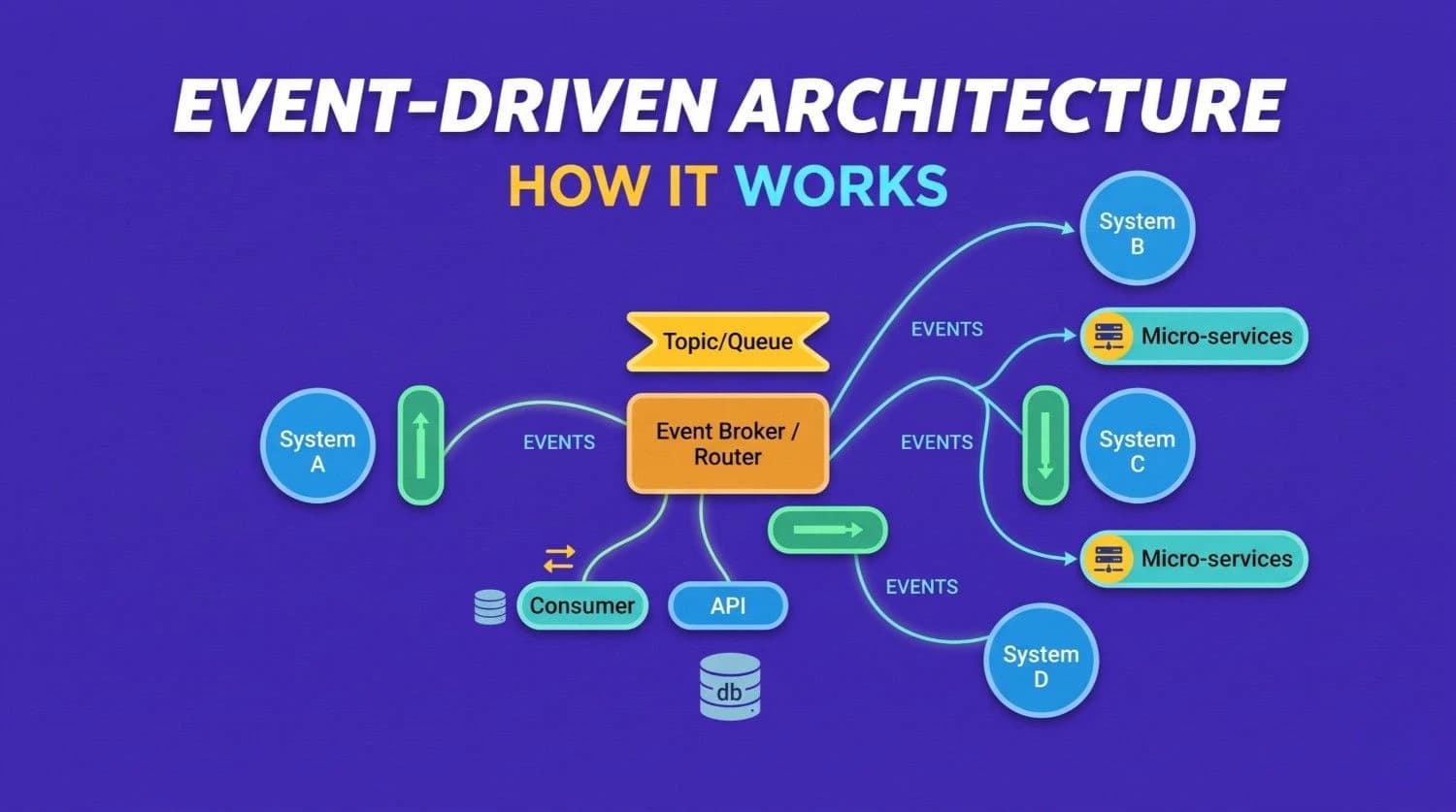
Modern applications rarely operate as isolated systems. An e-commerce platform, for example, may need to update inventory, process payments, send order confirmations and arrange deliveries whenever a customer completes a purchase. Managing these operations through tightly connected services can make applications harder to maintain and scale.
Event-Driven Architecture (EDA) offers another approach. Instead of requiring services to communicate directly with every other component, it allows them to exchange information through events. Each service can respond to relevant changes independently, making it easier to build flexible and distributed applications.
Understanding how Event-Driven Architecture works, its core components and its implementation challenges helps developers determine when this architecture is suitable for modern software systems.
Event-Driven Architecture is a software design pattern in which applications communicate by producing, distributing and consuming events.
An event represents something that has already happened within a system. Examples include a customer placing an order, a payment being completed, a user registering or a file being uploaded.
Instead of directly calling multiple services whenever an action occurs, the responsible service publishes an event. Other services interested in that event receive it and perform their respective tasks.
For example, when an online customer places an order, the order service can publish an OrderPlaced event. Inventory, payment and notification services can independently consume that event and execute their required operations.
This approach reduces direct dependencies between services and supports asynchronous communication.
An event-driven system generally follows a sequence involving event generation, distribution and processing.
1. Event Producer Generates an Event
An event producer is an application, service or component responsible for detecting a change and publishing an event.
For example, when a customer completes an online purchase, the order service generates an OrderPlaced event.
An event usually contains information such as its unique identifier, event type, timestamp and relevant business data.
2. Event Broker Receives and Distributes Events
The producer sends the event to an intermediary component called an event broker or event router.
The broker manages event distribution and delivers relevant events to subscribed consumers. Depending on the infrastructure, it may also support filtering, message persistence, retries and delivery management.
Popular technologies include Apache Kafka, RabbitMQ, Amazon EventBridge and Google Cloud Pub/Sub.
3. Event Consumers Process the Information
Event consumers are services that subscribe to particular event types and execute actions when they receive relevant messages.
For an OrderPlaced event:
The inventory service updates product availability.
The payment service processes the payment workflow.
The notification service sends an order confirmation.
The analytics service records the transaction.
These operations can happen independently rather than requiring the original order service to coordinate every action directly.
4. Services Generate Additional Events
After processing an event, a consumer may publish another event describing the result.
For example, the payment service may publish PaymentCompleted after successfully processing a transaction. The shipping service can then respond to that event and begin preparing the delivery.
This creates a sequence of interconnected business operations.
Understanding the main components helps developers design reliable event-driven applications.
Event: A record of something that has happened, such as an order being placed or a payment being completed. Events are generally treated as immutable facts.
Event Producer: The service or application that generates and publishes events.
Event Broker: The intermediary infrastructure that receives, routes or distributes events between different components.
Event Consumer: A service that receives and processes events relevant to its responsibilities.
Event Channel: The communication pathway through which events are published and consumed. Depending on the technology, this may be a queue, topic or event stream.
Together, these components allow applications to communicate without requiring every service to know the internal implementation of other services.
Event-driven systems can use different communication patterns depending on the application's requirements.
1. Event Notification
In event notification, a service publishes a message to inform other components that something has happened.
The event usually contains limited information, such as an order ID or customer ID. Consumers can retrieve additional details from the source service if required.
This pattern is useful when multiple services need to know about a change without receiving the entire business record.
2. Event-Carried State Transfer
In this pattern, the event contains relevant information about the state change itself.
For example, when a customer updates their delivery address, the event may include the updated address. Other services can use this information to update their own data without repeatedly requesting it from the original service.
This reduces communication dependencies but introduces the responsibility of maintaining consistent copies of data.
3. Event Sourcing
Event sourcing is a different but related architectural pattern in which application state is stored as a sequence of events rather than only as the latest database record.
For example, a bank account may have events such as AccountCreated, MoneyDeposited and MoneyWithdrawn. The current balance can be reconstructed by replaying the relevant events.
Event sourcing can improve auditability and support historical state reconstruction. However, it introduces additional complexity around event versioning, replay and data projections.
Importantly, using Event-Driven Architecture does not automatically mean implementing event sourcing.
EDA is particularly useful when multiple services need to react to the same business event.
E-Commerce and Order Processing
An online shopping platform can use events to coordinate order confirmation, inventory updates, payment processing and delivery preparation.
Each service handles its own responsibility, allowing additional functionality to be introduced without redesigning the entire order-processing workflow.
Financial Services
Financial applications can use event-driven systems to process transaction notifications, monitor account activity and trigger fraud-detection workflows.
However, financial operations still require carefully designed transaction guarantees, authorization and consistency controls.
IoT and Smart Devices
Connected devices generate events from sensors, environmental changes and equipment activity.
An event-driven architecture can distribute these updates to monitoring systems, analytics services and automated alerting applications.
Real-Time Analytics
Businesses can process incoming events to monitor website activity, application performance and customer interactions.
Event streams allow analytics systems to process information continuously rather than waiting for periodic data collection.
EDA offers several advantages for applications with distributed workloads.
Loose coupling: Producers do not need to know which services consume their events. New consumers can be added without changing the producer's business logic.
Independent scalability: Services can scale according to their individual processing requirements.
Asynchronous processing: Producers can publish events without waiting for every consumer to finish processing them.
Improved extensibility: Developers can introduce additional functionality by subscribing new services to existing event types.
Fault isolation: A temporary failure in one consumer does not necessarily prevent other consumers from processing the same event, provided the broker and delivery configuration support it.
These benefits make EDA particularly useful for applications with multiple independent services and changing workloads.
Despite its advantages, Event-Driven Architecture introduces challenges that require careful engineering.
Eventual consistency: Different services may temporarily hold different versions of the data because events are processed asynchronously.
Duplicate delivery: Some messaging systems provide at-least-once delivery, meaning consumers may receive the same event more than once. Idempotent processing helps prevent duplicate operations.
Event ordering: Events may arrive or be processed out of sequence, especially when multiple consumers process messages concurrently.
Debugging complexity: A single business operation can involve several services, making it harder to trace failures across the entire workflow.
Message failures: Consumers may fail while processing events. Retry strategies, dead-letter queues and monitoring are necessary to handle unsuccessful messages.
Developers should also consider the transactional outbox pattern when a service must reliably save a database change and publish its corresponding event without risking inconsistency between those operations.
Start by identifying meaningful business events rather than creating messages for every minor application activity.
Use consistent event naming and versioned schemas so different services can understand the same information as applications evolve. CloudEvents is one specification that helps standardize event metadata across systems.
Implement idempotent consumers, configure retry policies and monitor consumer lag. For workflows involving multiple services, consider choreography or orchestration depending on how much centralized coordination is required.
Most importantly, introduce event-driven communication where asynchronous processing provides a genuine architectural advantage. A simple application with a few tightly related operations may be easier to maintain using conventional request-response communication.
1. What is the main purpose of Event-Driven Architecture?
The main purpose is to allow different application components to communicate through events. This reduces direct dependencies between services and enables them to respond independently to changes within a system.
2. How does Event-Driven Architecture work?
A producer generates an event and publishes it to an event broker or communication channel. The broker distributes the event to interested consumers, which process the information and may generate additional events.
3. What are the main components of EDA?
The main components are event producers, events, event brokers or routers, event channels and event consumers. Together, they support asynchronous communication between application components.
4. What is the difference between Event-Driven Architecture and microservices?
Microservices describe an approach to structuring applications as independently deployable services. Event-Driven Architecture describes a communication and interaction pattern based on events. Microservices can use EDA, but they can also communicate through synchronous APIs.
5. Is Event-Driven Architecture suitable for every application?
No. EDA is particularly useful for distributed applications that need asynchronous processing and independent service communication. Smaller applications with straightforward workflows may be easier to manage using traditional request-response patterns.
Event-Driven Architecture provides a flexible way to connect application components through asynchronous events rather than relying entirely on direct service-to-service communication.
By separating event producers from consumers, developers can build systems that are easier to extend, independently scale and adapt to changing business requirements. However, successful implementation requires attention to event delivery, consistency, duplicate processing, ordering and monitoring.
The most effective approach is to understand the application's communication requirements before adopting EDA. When used appropriately, it can become a valuable foundation for building reliable distributed applications and modern software systems.
Written by
Alaffiya Madarwala
Last updated
25 November 2026
Comments
In this article
What Is Event-Driven Architecture?
How Does Event-Driven Architecture Work?
Core Components of Event-Driven Architecture
Types of Event-Driven Architecture Patterns
Real-World Applications of Event-Driven Architecture
Benefits of Event-Driven Architecture
Challenges Developers Should Consider
Expert Tips
Frequently Asked Questions
Conclusion