
Difference Between C and C++ You Should Know

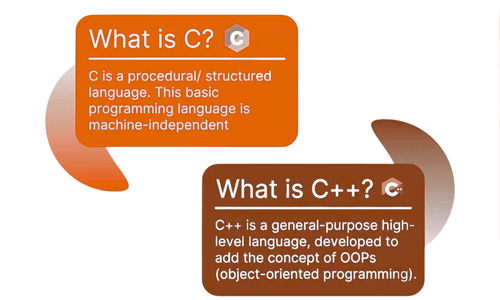
If you’ve just started your journey into programming, chances are you’ve heard about C and C++. These two languages are often spoken of together because C++ was originally created as an extension of C. But while they may look similar in syntax, they are quite different in how they work and what they can do.
Understanding the difference between C and C++ will help you choose the right language for your goals—whether that’s learning the basics of coding, building software, or exploring modern technologies like AI, operating systems, or game development.
A Short History: How It All Began
The story starts in the early 1970s at Bell Labs, where Dennis Ritchie developed C to create efficient system software, especially operating systems like UNIX. C became popular for its simplicity, speed, and control over hardware.
A decade later, Bjarne Stroustrup wanted to make programming more organised and scalable. He extended C by adding classes, objects, and other features—calling this new language “C with Classes”, which later became C++.
Think of it like this:
C is like a solid foundation of a building—strong and reliable.
C++ is the same foundation, but with added floors, modern design, and more flexibility.
Key Difference Between C and C++
Let’s go step by step and see how both languages differ.
Feature | C | C++ |
Programming Type | Procedural (focuses on functions) | Object-Oriented (focuses on objects and data) |
Approach | Top-down approach | Bottom-up approach |
Data Security | No built-in encapsulation | Supports encapsulation and abstraction |
Functions | Cannot be overloaded | Function and operator overloading supported |
Classes and Objects | Not supported | Fully supports classes, inheritance, polymorphism |
Error Handling | Manual (using return values or setjmp) | Has built-in try, catch, and throw exception handling |
Namespaces | Not available | Available to avoid naming conflicts |
Memory Management | Uses malloc() and free() | Uses new and delete operators |
Input/Output | Uses printf() and scanf() | Uses cin and cout |
Standard Libraries | Smaller, focused on basic operations | Includes the Standard Template Library (STL) for data structures and algorithms |
Paradigm Support | Procedural only | Multi-paradigm (procedural, object-oriented, generic) |
A Simple Example
Let’s take an example to see one of the major differences between the two.
In C (Procedural Way)
#include <stdio.h>

int main() {
    int a = 5, b = 10;
    int sum = a + b;
    printf("Sum: %d", sum);
    return 0;
}
C focuses on functions and steps to perform a task. Everything is procedural — you tell the program how to do it.
In C++ (Object-Oriented Way)
#include <iostream>

using namespace std;
class Calculator {

public:
    int add(int a, int b) {
        return a + b;
    }
};


int main() {
    Calculator obj;
    cout << "Sum: " << obj.add(5, 10);
    return 0;
}
C++ focuses on objects that bundle both data and functions together. This makes the program more structured, reusable, and easier to maintain as it grows.
Major Conceptual Differences Explained Simply
1. Programming Style
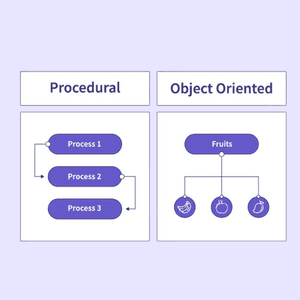
C is procedure-oriented, meaning the focus is on writing functions that perform actions.
C++ is object-oriented, which means the focus shifts to creating objects that represent real-world entities.
2. Data Protection
In C, all variables can be accessed freely, which can cause accidental errors.
In C++, data can be hidden and protected inside classes, making your program more secure and organised.
3. Reusability
In C, if you want to reuse code, you must copy it.
In C++, you can create classes once and reuse them anywhere—this is one of its strongest advantages.
4. Error Handling
C uses manual methods like checking return values, which can be tedious.
C++ introduces exception handling (try, catch, throw) that lets you manage errors gracefully.
5. Performance and Speed
Both are fast, but C++ programs can be slightly larger because of the extra features.
However, C++ offers more flexibility without losing much speed—making it ideal for complex software like games and AI engines.
When Should You Use C or C++?
Choose C if you want to:
Learn how computers really work under the hood.
Build system-level software, compilers, or embedded systems.
Focus on speed, simplicity, and portability.
Choose C++ if you want to:
Learn modern programming concepts like objects, inheritance, and polymorphism.
Create large-scale applications, games, or tools with complex logic.
Work in industries like software engineering, robotics, or game design.
In simple terms:
C teaches you how computers think.
C++ teaches you how to organise your thoughts for computers.
Can C and C++ Work Together?
Yes! You can mix C and C++ in the same project. For example, you can write performance-critical code in C and use C++ for the user interface or business logic.
Developers often use extern "C" in C++ to make sure both languages can share code smoothly.
Common Misconceptions
“C is outdated.”
Not true! C still powers the core of operating systems, databases, and embedded devices.
“C++ is just C with more features.”
Not exactly. C++ has evolved into a full-fledged, multi-paradigm language—it’s far more than an extension.
“You must learn C before C++.”
Helpful, but not necessary. You can start directly with C++ if your goal is application development.
Conclusion
C and C++ may look similar on the surface, but they serve different purposes.
C gives you raw power and simplicity, while C++ gives you structure and flexibility.
For beginners, understanding the difference between C and C++ is the first step towards mastering programming. Once you grasp these differences, you’ll have a clearer path to decide which language fits your goals—and maybe even use both as you grow in your coding journey.
Written by
Shreyashri
Last updated
18 June 2026